
Is It Normal to Be Sore After a Deep Tissue Massage?
What the Research Says About Soreness, Bruising and Pressure, Explained for Mesa Clients
Deep tissue is the massage people in Mesa ask for when something hurts: a stiff neck from a desk job, a low back that tightens after yard work, shoulders that never quite let go.
It is also the massage that brings the most worried questions afterward. Is this soreness normal? Should I have bruises? Did the therapist go too hard, or not hard enough?
Most answers online come from spas repeating each other. We went to the studies instead, and here is the short version.
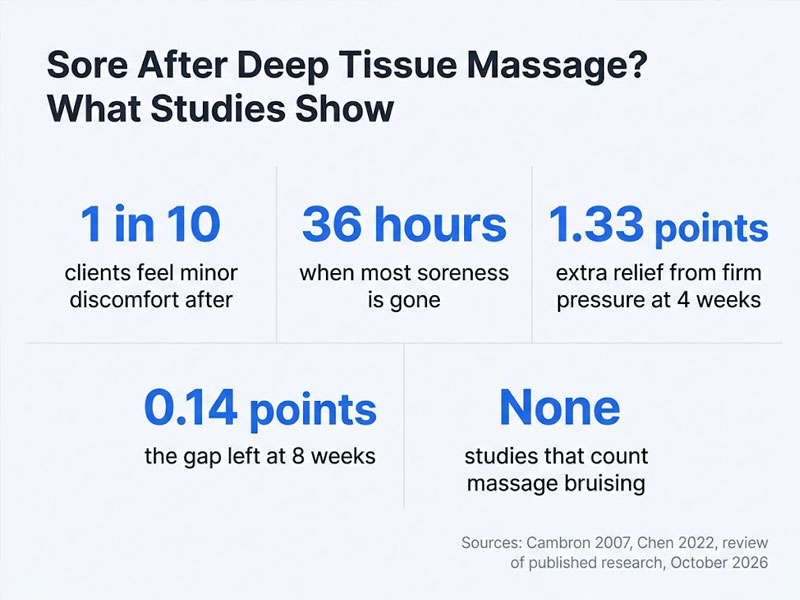
About 1 in 10 massage clients report minor discomfort afterward, and it usually clears within 36 hours. The best trial on pressure found firmer work helped more for four weeks, then the advantage faded. Nobody has measured how often massage causes bruising, which matters more in Mesa than in most cities.
This article explains published research in plain English. It is not a diagnosis or treatment plan. If you have a medical condition, take blood thinners, are pregnant or have had recent surgery, talk to your doctor before booking deep pressure work, and tell your massage therapist on your intake form.
- 1 in 10About 10% of massage clients reported minor discomfort after a session. Most of it started within 12 hours and was gone within 36. Cambron et al. 2007
- 1.33 pointsFirm pressure lowered back pain 1.33 points more than light pressure on a 0 to 10 scale after four weeks of treatment. Chen et al. 2022
- 0.14 pointsBy the eight-week follow-up, the gap between firm and light pressure had shrunk to 0.14 points, too small to be statistically significant. Chen et al. 2022
- 400Back pain patients in a trial where relaxation massage helped about as much as structural massage, which surprised the therapists. KP Washington
- 138Adverse events linked to massage in 11 years of published reports worldwide. Most involved spinal manipulation, not ordinary massage. Yin et al. 2014
- 18%Share of U.S. adults with no heart attack or stroke history who regularly take a daily low-dose aspirin, one of the medications that make bruising easier. Annenberg PPC
- How Many People Feel Sore After a Massage? About 1 in 10
- Does Deeper Pressure Work Better? For 4 Weeks, Then the Gap Closed
- Is Bruising a Sign Your Massage Worked? No Study Has Counted It
- How Rare Are Serious Injuries? 138 Reports in 11 Years, Worldwide
- What Does Deep Tissue Actually Mean? There Is No Standard Definition
- Does Massage Help Workout Soreness? Yes, Most at 48 Hours
- Explore all the data
- Frequently asked questions
1How Many People Feel Sore After a Massage? About 1 in 10
In a survey of 91 massage clients, 10% reported minor discomfort after their session. Most of it started within 12 hours and lasted 36 hours or less, and the study recorded no major side effects. Meanwhile, 23% reported unexpected positive effects.
- 10% of clients reported minor discomfort after the massage.
- Within 12 hours: when most of that discomfort started.
- 36 hours or less: how long most of it lasted.
- 23% reported unexpected positive effects instead.
That figure surprises people who assume everyone walks out of a deep tissue session aching. Nine in ten clients in that survey did not report discomfort at all. Soreness is a possible side effect, not a requirement.
The study is small and comes from a single teaching clinic in 2007, so treat the exact percentage as a rough guide. It still lines up with what experienced therapists describe: some tenderness in the areas that got focused work, fading over the next day.
Most post-massage discomfort is gone within a day and a half. Soreness that is still building on day three is worth a phone call.
Source: Cambron et al. 2007What normal soreness looks like, and what it does not
Discomfort that shows up the same evening and eases by the next afternoon fits the normal pattern. These do not fit it:
- Sharp pain, or pain in a joint or along the spine
- Pain that spreads into an arm or leg, or comes with numbness or tingling
- Swelling, heat or redness that grows instead of fading
- Soreness that gets worse after the second day
Any of those is a reason to call your therapist and, if it continues, a doctor. If you are new to massage and want to know what else is normal, our guide on whether it is rude to fall asleep during a massage covers the common worries.
Some people also feel unexpectedly emotional or lightheaded afterward. That is a separate response from muscle soreness, and we explain it in why you might feel emotional after a massage.
2Does Deeper Pressure Work Better? For 4 Weeks, Then the Gap Closed
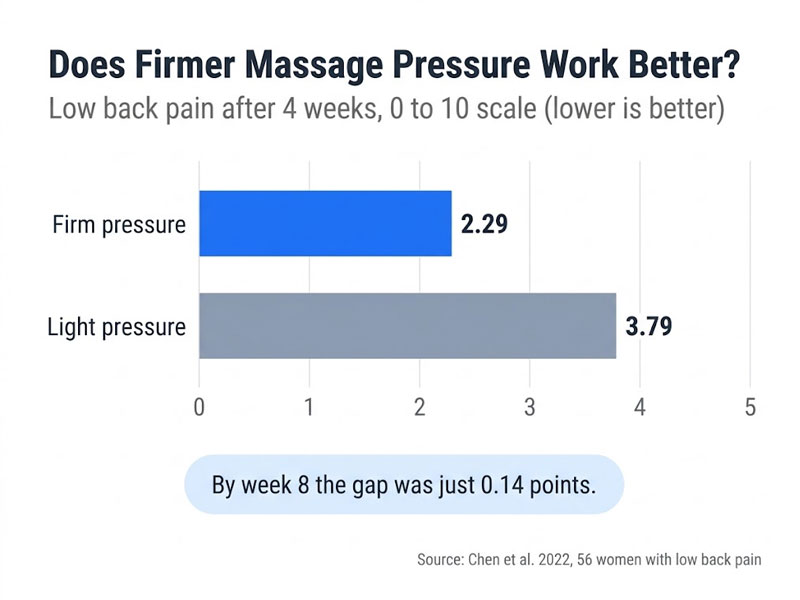
In a randomized trial of 56 women with low back pain, firm pressure left pain scores 1.33 points lower than light pressure after six sessions (2.29 versus 3.79 on a 0 to 10 scale). By the eight-week follow-up, the gap was 0.14 points, too small to count.
Pain after four weeks, 0 to 10 scale (lower is better)
At eight weeks, the difference between the groups was 0.14 points and not statistically significant. Chen et al. 2022
This is the closest thing the research has to an answer on pressure, and it is a fair result for both camps. Firm pressure, defined in the trial as 2 kg of force or more on the focus area, did produce more relief by the end of treatment.
It did not produce more lasting relief. The trial was small and enrolled only women, so it cannot settle the question for everyone, but it is a controlled comparison rather than a testimonial.
Firm pressure won the short race. By week eight, both groups had ended up in about the same place.
Source: Chen et al. 2022A separate line of research points the same way. A study of 20 healthy adults found moderate pressure triggered a stronger relaxation response in the nervous system than light pressure did (Diego et al. 2009).
Moderate is the key word. None of this research supports pressure so heavy that you hold your breath, tense up or brace against the therapist’s hands. Bracing works against the muscle you are trying to release.
In practice, ask for firm pressure if you like it, and speak up the moment it tips into pain. Therapists adjust constantly, but only if you tell them. If talking on the table feels awkward, read do I have to talk during my massage for the few words that actually help.
3Is Bruising a Sign Your Massage Worked? No Study Has Counted It
No study we found measures how often massage causes bruising, so the claim that a bruise proves a good session has no data behind it. Medications such as aspirin, NSAIDs, corticosteroids and blood thinners like warfarin make bruising more likely, according to the American Massage Therapy Association.
This is the live argument on social media right now. One camp posts bruised backs as proof of a hard-working session. The other insists pain is never the goal.
The research sides with the second camp by default. A bruise means small blood vessels broke under pressure. It is not a measure of muscle release, and no trial we found has used it as one.
Why this matters more in Mesa
- 17.2% of Mesa residents are 65 or older, before counting winter visitors (U.S. Census).
- 18% of U.S. adults with no history of heart attack or stroke say they regularly take a daily low-dose aspirin, in a national survey of 1,771 adults (Annenberg PPC).
- The NIH notes that the rare serious injuries reported after massage have involved vigorous techniques such as deep tissue massage, or people at higher risk such as elderly people (NIH NCCIH).
Nearly one in five U.S. adults with no heart attack or stroke history takes a daily low-dose aspirin, a common reason for easy bruising.
Source: Annenberg PPCNone of that means older clients or aspirin users cannot enjoy a massage. It means the intake form matters.
Tell your therapist about blood thinners, aspirin, steroids, recent surgery or easy bruising. For clients on medications that cause bruising, the AMTA advises therapists to skip deep kneading, muscle stripping and trigger point compression and use gentle compression and friction instead (AMTA).
If you are not sure deep tissue is the right fit at all, our guide to choosing the right type of massage walks through the options.
4How Rare Are Serious Injuries? 138 Reports in 11 Years, Worldwide
A systematic review found 138 adverse events linked to massage in 40 published reports from 12 countries over 11 years. Most involved spinal manipulation. Massage therapists were involved in 5.8% of cases, compared with 23.9% for chiropractors.
| Who was involved | Share of the 138 events |
|---|---|
| Chiropractors | 23.9% |
| Massage therapists | 5.8% |
| Unregistered practitioners and other health workers | The remainder |
Set against the number of massages given every year, that count is tiny. The review’s authors concluded that massage is not risk-free, but the incidence of serious events is low.
The pattern inside the numbers is the useful part. The worst outcomes clustered around forceful twisting and manipulation of the neck and spine, often by unregistered practitioners, rather than the slow, sustained pressure a trained therapist uses in deep tissue work.
Most serious massage injuries in the medical literature trace back to forceful spinal manipulation, not to a massage therapist’s ordinary work.
Source: Yin et al. 2014The practical takeaway: choose a licensed therapist, expect a health intake before your first session, and be wary of anyone who cracks or yanks your neck as part of a massage.
If you have osteoporosis, a history of blood clots or recent surgery, say so up front. Those are the situations where the rare serious cases tend to appear.
If price or time pressure is pushing you toward a rushed session somewhere else, compare first. Our Mesa massage price list shows what each service costs.
5What Does Deep Tissue Actually Mean? There Is No Standard Definition
A review of the research found no commonly accepted definition of deep tissue massage; most studies define it by the therapist’s intent. In a trial of 400 back pain patients, more than one in three massage patients said their pain was much better or gone at 10 weeks, against one in 25 on usual care.
Because the term has no fixed meaning, two studios can both offer deep tissue and deliver very different sessions (Koren and Kalichman). That is why the menu label matters less than the conversation at the start: which areas, how firm, and what you want to be able to do afterward.
Many therapists focus deeper work on one or two areas rather than the whole body. That is usually what a sore back or neck needs.
Deep versus gentle: what the trials found
- Structural vs relaxation massage, 400 patients: both helped chronic low back pain. More than one in three massage patients said their pain was much better or gone at 10 weeks, versus one in 25 on usual care (KP Washington).
- The surprise: co-investigator Karen Sherman said the therapists assumed structural massage would win, and were surprised when the relaxation group got so much relief (Medical News Today).
- Deep tissue alone vs deep tissue plus anti-inflammatory drugs, 59 patients: two weeks of deep tissue massage lowered pain from a starting score of 58.3 out of 100, and the authors concluded adding the drugs gave a similar degree of relief (Majchrzycki et al.).
More than one in three massage patients in the 400-person trial said their back pain was much better or gone at 10 weeks, whether the massage was structural or relaxation.
Source: KP WashingtonFor most people, the right answer is firm, targeted work at a pressure you can breathe through, with enough time to warm the tissue first.
If you are deciding how long to book, see 60 vs 90 minutes and which to book. If a myth about massage has kept you from booking, start with five massage myths that keep people away.
6Does Massage Help Workout Soreness? Yes, Most at 48 Hours
A meta-analysis of 11 studies and 504 participants found massage after hard exercise reduced muscle soreness, with the biggest effect at 48 hours (a standardized difference of -1.51, versus -0.61 at 24 hours). Exercise soreness itself peaks between 24 and 72 hours after a workout.
This is good news for Mesa runners, hikers and gym regulars who book deep tissue after a hard week. The pooled evidence says massage reduces post-exercise soreness, though the authors note the studies vary a lot in quality and method (Guo et al. 2017).
Exercise soreness typically peaks a day to three days out (Huang et al. 2020). Booking your session the day after a big effort, rather than right before one, fits the data. Our guide on massage before or after a workout goes deeper on that choice.
Massage had its biggest effect on workout soreness at the 48-hour mark in the pooled studies.
Source: Guo et al. 2017Massage does not flush lactic acid
In a controlled study of 12 people, massage actually reduced blood flow and lactic acid removal from exercised muscle compared with simply resting (Wiltshire et al. 2010). Whatever massage does for soreness, it is not a toxin flush.
The advice to drink water after a massage is still sensible in Arizona, simply because Mesa heat dehydrates you. A light snack and water before your session help too, as we explain in should I eat before my massage.
Questions about pressure, bruising or medications before you book? Contact our Mesa studio and we will tell you honestly whether deep tissue, a firmer Swedish session or something gentler fits.
Explore All the Data in This Guide
Every figure in this article, in one table. Search for a word, filter by topic, or tap a column header to sort.
| What was measured | Figure | Topic | Source |
|---|---|---|---|
| Clients reporting minor discomfort after a session | 10% | Soreness | Cambron et al. 2007 |
| Typical onset of discomfort | 12 hours | Soreness | Cambron et al. 2007 |
| Typical duration of discomfort | 36 hours | Soreness | Cambron et al. 2007 |
| Clients reporting unexpected positive side effects | 23% | Soreness | Cambron et al. 2007 |
| Clients who completed the side-effect survey | 91 | Soreness | Cambron et al. 2007 |
| Major side effects recorded | No major side-effects | Soreness | Cambron et al. 2007 |
| When exercise-induced muscle soreness peaks | between 24 and 72 h | Workout recovery | Huang et al. 2020 |
| Pain at week 4, firm pressure (0-10 scale) | 2.29 | Pressure | Chen et al. 2022 |
| Pain at week 4, light pressure (0-10 scale) | 3.79 | Pressure | Chen et al. 2022 |
| Difference at week 8 follow-up (points) | 0.14 | Pressure | Chen et al. 2022 |
| Participants in the pressure trial | 56 | Pressure | Chen et al. 2022 |
| Sessions in the pressure trial | Six | Pressure | Chen et al. 2022 |
| Participants, moderate vs light pressure nervous-system study | 20 | Pressure | Diego et al. 2009 |
| Patients in the structural vs relaxation massage trial | 400 | Deep tissue research | KP Washington |
| Massage patients whose pain was much better or gone at 10 weeks | one in three | Deep tissue research | KP Washington |
| Usual-care patients whose pain was much better or gone | one in 25 | Deep tissue research | KP Washington |
| Therapists’ expectation vs result | relaxation group got so much relief | Deep tissue research | Medical News Today |
| Low back pain score, deep tissue massage alone (0-100), before and after | 58.3 | Deep tissue research | Majchrzycki et al. |
| Patients in deep tissue vs NSAIDs trial | 59 | Deep tissue research | Majchrzycki et al. |
| Accepted definition of deep tissue massage | no commonly accepted definition | Deep tissue research | Koren and Kalichman |
| Adverse events reported worldwide, 2003-2013 | 138 | Serious injuries | Yin et al. 2014 |
| Published reports behind them | 40 | Serious injuries | Yin et al. 2014 |
| Cases involving massage therapists | 5.8% | Serious injuries | Yin et al. 2014 |
| Cases involving chiropractors | 23.9% | Serious injuries | Yin et al. 2014 |
| Countries represented | 12 | Serious injuries | Yin et al. 2014 |
| Adults with no heart attack or stroke history who regularly take daily low-dose aspirin | 18% | Bruising and risk | Annenberg PPC |
| Adults surveyed | 1,771 | Bruising and risk | Annenberg PPC |
| Mesa residents aged 65 and over | 17.2% | Bruising and risk | U.S. Census |
| Studies counting how often massage causes bruising | None found in our search | Bruising and risk | Yin et al. 2014 |
| Participants in massage-for-soreness meta-analysis | 504 | Workout recovery | Guo et al. 2017 |
| Studies pooled | 11 | Workout recovery | Guo et al. 2017 |
| Soreness reduction at 48 h (standardized mean difference) | -1.51 | Workout recovery | Guo et al. 2017 |
| Soreness reduction at 24 h (SMD) | -0.61 | Workout recovery | Guo et al. 2017 |
| Subjects in lactic-acid removal study | 12 | Workout recovery | Wiltshire et al. 2010 |
| Massage types involved in reported serious injuries | deep tissue massage | Bruising and risk | NIH NCCIH |
| Group NCCIH names as higher risk of injury | elderly people | Bruising and risk | NIH NCCIH |
| Medications that make bruising more likely | Aspirin | Bruising and risk | AMTA |
| Blood thinner named by Mayo Clinic physician as raising bruising risk | Warfarin | Bruising and risk | AMTA |
Frequently Asked Questions
Is it normal to be sore after a deep tissue massage?
Yes, mild soreness is common but not universal. In a survey of 91 massage clients, about 10% reported minor discomfort afterward; most of it began within 12 hours and was gone within 36. Soreness that is sharp, gets worse after day two, or comes with numbness is not typical and is worth reporting to your therapist or doctor.
How long does soreness last after a deep tissue massage?
Usually a day or two. The 2007 client survey found most post-massage discomfort lasted 36 hours or less. Exercise-related muscle soreness, by comparison, peaks between 24 and 72 hours. If you are still sore on day four or five, or the pain is in a joint or along the spine, tell your therapist before your next session.
Is bruising after a massage normal?
Bruising can happen, but no study we found measures how often, and nothing shows a bruise means the massage worked. Medications including aspirin, NSAIDs, corticosteroids and blood thinners such as warfarin make bruising more likely, according to the American Massage Therapy Association. If you take any of them, tell your therapist before firm pressure.
Does deeper pressure work better for back pain?
Only briefly, in the best trial available. Women with low back pain who got firm pressure (2 kg or more) scored 1.33 points lower on a 0-10 pain scale than a light-pressure group after four weeks, but by eight weeks the gap was 0.14 points and no longer significant. Firm, comfortable pressure is reasonable; pain is not the goal.
Is deep tissue better than Swedish massage for chronic back pain?
Not clearly. A trial of 400 patients with chronic low back pain compared structural massage with relaxation (Swedish) massage. Both groups improved, more than one in three massage patients said their pain was much better or gone at 10 weeks, and the researchers said therapists were surprised by how much relief the relaxation group got.
Can a deep tissue massage injure you?
Serious injury is rare. A systematic review found 138 adverse events in published reports worldwide over 11 years, and most involved spinal manipulation rather than ordinary massage; massage therapists were involved in 5.8% of cases. Tell your therapist about blood clots, recent surgery, osteoporosis or blood thinners before a session.
Should I drink water to flush toxins after a massage?
Drink water because you are in Arizona, not because of toxins. A 12-person study found massage actually lowered blood flow and lactic acid removal from exercised muscle compared with rest, which undercuts the idea that massage flushes waste. Staying hydrated still helps you feel better, especially in Mesa heat.
How We Researched This
- We started from the questions Mesa clients and online massage forums ask most about deep tissue soreness, bruising and pressure.
- We read the original studies, reviews and agency pages behind every figure, and checked each number against its source.
- We looked for newer research published in the last 30 days and found none that changes these figures.
- Limits: no study we found counts how often massage causes bruising, the pressure trial enrolled 56 women, the side-effect survey covered 91 clients at one clinic, and no Mesa or Arizona outcome data exists.
Sources
- Chen et al. (2022). The Effect of Massage Force on Relieving Nonspecific Low Back Pain: A Randomized Controlled Trial. International Journal of Environmental Research and Public Health.
- Cambron et al. (2007). Side-effects of massage therapy: a cross-sectional study of 100 clients. Journal of Alternative and Complementary Medicine. Summary by PainScience.
- Kaiser Permanente Washington Health Research Institute (2011). Massage eases low back pain in randomized controlled trial.
- Medical News Today (2011). Coverage of the Group Health trial of structural and relaxation massage for low back pain.
- Majchrzycki et al. (2014). Deep Tissue Massage and Nonsteroidal Anti-Inflammatory Drugs for Low Back Pain: A Prospective Randomized Trial. The Scientific World Journal.
- Koren and Kalichman (2018). Deep tissue massage: What are we talking about? Journal of Bodywork and Movement Therapies.
- Yin et al. (2014). Adverse Events of Massage Therapy in Pain-Related Conditions: A Systematic Review. Evidence-Based Complementary and Alternative Medicine.
- NIH National Center for Complementary and Integrative Health. Massage Therapy: What You Need To Know.
- Tosch, H. (2014). Massage and Medication. Massage Therapy Journal, American Massage Therapy Association.
- Annenberg Public Policy Center (2025). Nearly half of adults mistakenly think benefits of daily aspirin outweigh risks.
- U.S. Census Bureau. QuickFacts: Mesa city, Arizona.
- Guo et al. (2017). Massage Alleviates Delayed Onset Muscle Soreness after Strenuous Exercise: A Systematic Review and Meta-Analysis. Frontiers in Physiology.
- Huang et al. (2020). Does Acupuncture Benefit Delayed-Onset Muscle Soreness After Strenuous Exercise? A Systematic Review and Meta-Analysis. Frontiers in Physiology.
- Diego and Field (2009). Moderate pressure massage elicits a parasympathetic nervous system response. International Journal of Neuroscience.
- Wiltshire et al. (2010). Massage impairs postexercise muscle blood flow and lactic acid removal. Medicine and Science in Sports and Exercise. Summary by PainScience.